
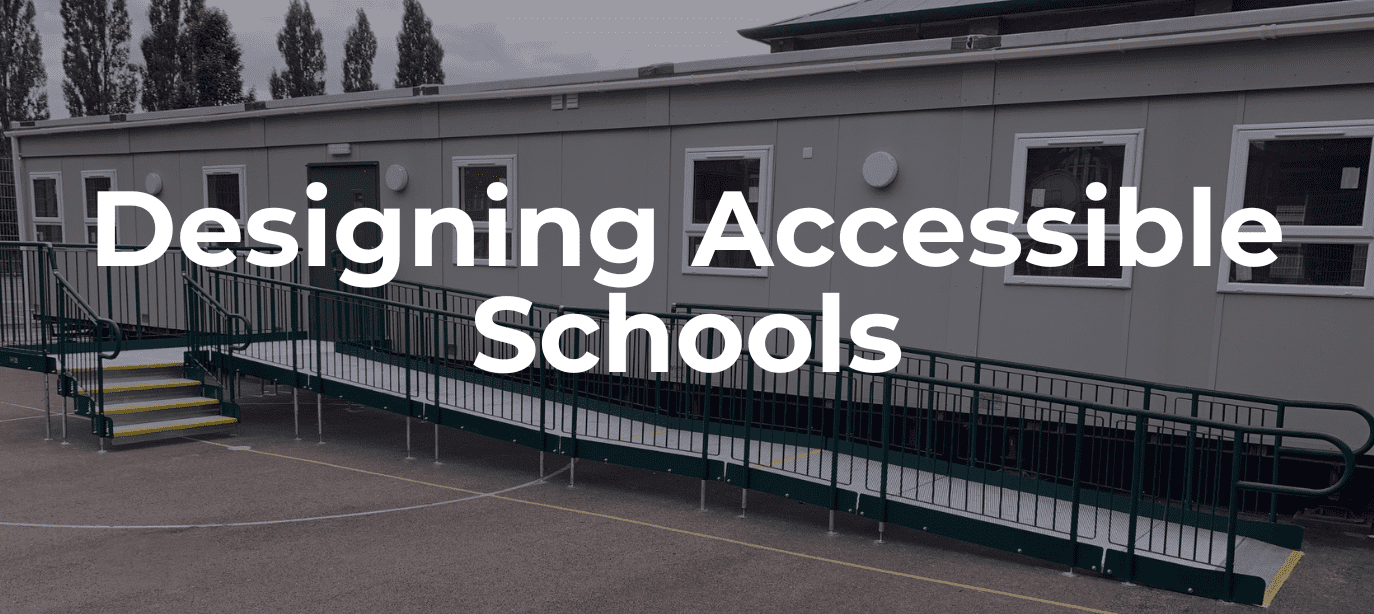
Creating a safe, compliant and inclusive school environment begins with accessible school design that meets UK accessibility standards. For facilities and premises managers, accessibility is not simply a matter of good intention – it is a legal and operational responsibility.
Ensuring your ramps, steps and safety surfaces meet the right specifications reduces risk, supports inspection readiness and demonstrates a commitment to pupil and staff welfare.
Accessible School Design – TL;DR Summary
Creating accessible schools isn’t just good practice – it’s a legal and operational responsibility. This guide outlines how school facilities managers can design safe, compliant environments that meet UK accessibility standards.
- Understand how accessible school design supports safety, inclusion and inspection readiness.
- Follow Part M, BS 8300, and Equality Act 2010 standards for ramps, steps and pathways.
- Select durable, slip-resistant materials such as GRP, textured concrete or expanded mesh for long-term performance.
- Explore modular access systems that deliver full compliance with flexibility and minimal disruption.
- Keep your site inspection-ready with regular audits, maintenance schedules and clear documentation.
At Nexus Adapt, we provide modular ramps for schools, handrails and step systems designed for lasting safety, flexibility and compliance with UK accessibility regulations.
Why School Accessibility Matters
Across the UK, around 24% of people identify as disabled, and many more experience temporary mobility challenges. Whether you are managing an existing site or planning refurbishments, accessibility is central to compliance with the Equality Act 2010 and Building Regulations Approved Document M. It also forms part of a school’s broader duty of care to ensure that every pupil, member of staff and visitor can move safely and independently around the premises.
Modern accessibility design must go beyond minimum standards. For schools, this means selecting durable materials, maintaining clear contrast between surfaces, and ensuring access routes are practical for daily use in all weather conditions. This guide provides a clear overview of the regulations, measurements and design principles you need to follow to achieve compliance, reduce maintenance costs and create a truly inclusive learning environment.
Understanding Access Ramp Requirements for Schools: Well-Designed Ramps Enable Independence
Accessible ramps are one of the most critical elements in meeting UK accessibility standards. Premises managers must ensure all ramps meet the correct gradient, length, and width requirements set out in Building Regulations Approved Document M. A properly designed ramp does more than meet standards – it supports daily independence, reduces accident risk, and demonstrates your site’s ongoing inspection readiness.
Gradient and Length Specifications for School Ramps
For permanent public access ramps, Building Regulations Part M specifies a maximum gradient of 1:15 for unassisted wheelchair access. Ramps longer than 10 metres must include intermediate level landings at least 1.5 metres deep. Landings should also appear at every top, bottom and directional change. Maintaining these dimensions ensures safety, usability and full regulatory compliance.
Choosing the Right Ramp Materials for Schools
Material choice plays a crucial role in both safety and maintenance. School ramps must withstand constant foot traffic and unpredictable British weather, so slip resistance and durability are essential. High-performance materials such as GRP (glass reinforced plastic), anti-slip expanded mesh, or textured concrete provide lasting traction and reliability. For low-maintenance performance, choose surfaces that promote drainage and resist algae growth, keeping access routes safe year-round.
Modular accessibility systems have become the preferred solution in school environments because they deliver full compliance with outstanding flexibility. Modular ramps and steps can be installed quickly with minimal disruption and easily adjusted or relocated as site layouts change. This adaptability ensures long-term value, consistent safety standards, and inspection readiness across your estate.

Slip resistance: Select surfaces with adequate slip resistance ratings. Anti-slip expanded mesh, GRP, textured concrete, or specialist resin-bound surfaces offer excellent grip year-round. Picture glass-reinforced plastic.

Durability: School environments experience heavy foot traffic daily. Materials must withstand constant use, impacts from bags and equipment, and exposure to the elements without degrading.

Maintenance considerations: Opt for materials that are easy to clean and inspect. Expanded mesh surfaces allow water drainage and reduce puddle formation, whilst concrete surfaces may require drainage.
Handrails and Edge Protection for School Ramps
Handrails are an essential part of accessible ramp design. In compliance with Part M and Inclusive Mobility guidance, handrails should be positioned between 900mm and 1000mm for adults, with a secondary lower rail around 600mm for children. Use contrasting colours to aid visibility. Include a 100mm raised kerb to prevent wheels or walking aids from slipping off the edge.
Designing Safe and Accessible Steps for Schools
Not every user finds ramps easier. For some, steps provide greater control and stability. Facilities managers must ensure steps are built to Part M standards, with consistent rise and going measurements and clear visual contrast on each tread. Properly designed steps support both accessibility and inspection-readiness.
Step Dimensions and Visual Contrast
- Rise and going: Each step should have a rise (height) between 150mm and 170mm, with a going (depth) of at least 300mm. Crucially, these measurements must remain consistent throughout the entire flight of steps-even minor variations can cause trips.
- Nosing design: Step nosings should be clearly defined and marked with contrasting colours to assist those with low vision. Avoid projecting nosings that can catch feet or mobility aids.
- Surface finish: Apply slip-resistant materials to all step treads, paying particular attention to outdoor steps where moss, ice, or wet leaves can create hazardous conditions.
- Visual Contrast:Visual contrast is equally important. Ensure step edges, particularly nosings, contrast strongly with both the tread and the floor surface. A luminance contrast of at least 30% helps people with reduced vision identify level changes.
- Handrails for Steps:Similar to ramps, steps require handrails on both sides, extending beyond the top and bottom steps. In school environments, consider installing dual-height handrails to accommodate both children and adults, ensuring inclusivity across all age groups.
Accessible Pathways and Outdoor Surfaces
Outdoor access routes are often overlooked in school accessibility planning. To ensure safe, independent movement for all users, pathways must be firm, smooth and wide enough for wheelchair users and those with mobility aids.
Use durable, low-maintenance materials such as resin-bound gravel, tarmac or concrete, which provide reliable traction and withstand year-round use.
Pathway Design Essentials
Camber and cross-falls: Keep gradients below 1:20 where possible and limit cross-falls to 1:40 to prevent wheelchair drift and maintain comfort.
Surface firmness: Avoid loose materials like gravel or bark chippings. Choose resin-bound or concrete surfaces that allow wheelchair users to move freely and safely.
Width and passing places: Maintain a clear width of at least 1.8 metres for two-way access. Where space is limited, provide passing places every 50 metres.
Maintenance and Accessibility Audits
Accessibility responsibility does not end at installation. School facilities managers should carry out regular inspections to identify wear, debris or structural issues. Conduct weekly visual checks and an annual independent accessibility audit. Maintain a written record of inspections to support regulatory compliance and budget planning.
Compliance and Regulations for School Accessibility
Every educational premises must comply with the Equality Act 2010, Building Regulations Part M and British Standard BS 8300. These frameworks define the legal and technical standards for accessibility in schools. Adhering to them protects your institution from liability, improves safety outcomes and ensures pupils and visitors can access all areas independently.
Key UK Regulations
Equality Act 2010: Requires schools to make reasonable adjustments to ensure disabled pupils aren’t substantially disadvantaged. This includes physical features of buildings and outdoor spaces.
Building Regulations Approved Document M: Sets technical standards for accessible design in new builds and major refurbishments, covering gradients, dimensions, and contrast requirements.
British Standards BS 8300: Provides detailed guidance on inclusive design for built environments, offering best practice recommendations beyond minimum regulatory requirements.
Planning for Compliance
Premises managers should:
- Conduct regular accessibility audits to identify barriers and prioritise improvements
- Involve disabled staff, pupils, and parents in design decisions
- Document all accessibility features and maintenance schedules
- Budget for accessibility improvements as part of long-term estate management
- Stay informed about regulatory updates and evolving best practices
Planning and Budgeting for Accessibility Upgrades
Accessibility improvements can be implemented strategically as part of long-term estate management. Focus initial investment on high-traffic areas such as entrances, corridors and toilets. Spread upgrades across multiple financial years to manage costs effectively. Prioritise solutions with proven whole-life cost benefits to reduce long-term maintenance demands.
Working with Specialist Accessibility Suppliers
Partnering with the right accessibility supplier is crucial for maintaining standards and quality. Choose contractors with specific experience in school environments, detailed technical documentation and certified installers. At Nexus Adapt, our team provides fully compliant designs, site surveys and installations for ramps, handrails and safety surfacing – ensuring your school meets standards from day one.
Top 10 Accessibility Mistakes Schools Should Avoid
Even the best intentions can go wrong when accessibility is left too late or handled without foresight. Here are ten common mistakes – and how to fix them before they become problems.
1. Treating Accessibility as an Afterthought
Accessibility should be part of your first design conversation – not an add-on when construction starts.
The fix: Bring accessibility into the initial design brief with your architects and contractors. The Equality Act 2010 makes this a requirement, not an option.
2. Assuming “Temporary” Means Non-Compliant
Modular or temporary classrooms must still meet Building Regulations Part M and DDA access standards.
The fix: Modular ramps and handrails can be fully compliant and removable. Plan them properly from the start.
3. Focusing Only on Wheelchair Access
Accessibility isn’t just about wheelchairs. It includes walking aid users, pupils with visual impairments, parents with pushchairs, and staff with mobility challenges.
The fix: Design for every user. Inclusive Mobility is an excellent guide to inclusive design beyond ramps.
4. Ignoring the School’s Growth Plan
Permanent ramps to temporary buildings can quickly become obstacles when layouts evolve.
The fix: Use reconfigurable access solutions that can move as your site grows.
5. Choosing the Cheapest Option
Cheap access products often cost more in the long run through replacements, fines, and maintenance.
The fix: Calculate whole-life cost – factoring durability, weather resistance, and compliance longevity over at least ten years.
6. Forgetting About Winter
Cold metal, ice, and standing water make ramps unsafe.
The fix: Opt for self-draining, anti-slip surfaces, and warm-touch handrails designed for British weather.
7. Not Involving Users in the Design
Your staff, SENCOs, and facilities team know daily access challenges better than anyone.
The fix: Involve end users early. Their feedback prevents expensive retrofits later.
8. Overlooking Contrast and Visibility
Good design isn’t only structural – it’s visual. Low-contrast nosings and surfaces create hazards for visually impaired users.
The fix: Follow BS 8300 guidance: 30-point luminance contrast and 55mm highlighted step nosings make every change in level clear.
9. Neglecting Regular Maintenance
Even the best-built ramp loses safety value if it’s covered in algae or debris.
The fix: Schedule weekly inspections and annual compliance checks. RoSPA recommends annual independent inspections to verify safety and wear.
10. Treating Accessibility as a Box-Ticking Exercise
True accessibility goes beyond regulations – it reflects the culture of your school.
The fix: Design environments that empower independence, safety, and inclusion for all. Accessibility isn’t an expense; it’s an investment in equality.
Creating a Compliant and Future-Proof School Environment
Designing accessible schools is not just a regulatory exercise – it is part of effective estates management. The most successful accessibility strategies are those that combine compliance with practicality, safety and long-term cost control.
Strong accessibility design should be:
- Compliant from the first day of installation
- Cost-effective across the full life of the product
- Flexible enough to adapt as your site develops
- Safe and reliable in all weather conditions
- Suitable for every member of the school community
For facilities and premises managers, accessibility improvements should form part of ongoing estate planning. Schedule regular inspections, update your accessibility audits annually and budget for gradual upgrades to meet new standards as they arise. The investment pays off through reduced liability, improved site usability and a stronger demonstration of compliance.
At Nexus Adapt, we work with schools and local authorities to design and install access solutions that meet all regulatory requirements and operational needs. Our team provides site surveys, compliant ramp and handrail installations, and maintenance support to help you stay inspection-ready and fully aligned with UK accessibility legislation.
Planning improvements for your school? Let’s talk about what works. Together, we can future-proof your facilities for every learner.

